
Why does good instruction matter at MSU?
Documenting teaching effectiveness is an essential practice because it provides a well-rounded picture of the impact of your work in the classroom. The most comprehensive understanding of your teaching relies on collecting evidence from multiple sources—students, colleagues or peers, and yourself.
Learn More About Teaching Effectiveness
The most comprehensive understanding of your teaching relies on collecting evidence from multiple sources—students, colleagues or peers, and yourself.

In this way, documenting teaching effectiveness can be thought of as a three-legged stool: each leg represents a vital source of evidence that contributes to balance and stability.
- Student Feedback as Evidence
- Instructor Feedback as Evidence
- Colleague Feedback as Evidence
Feedback from students offers insight into their learning experiences; evaluations from colleagues, administrators, and peers provide professional perspectives on your teaching; and self-reflection allows you to analyze and present your own growth, materials, and outcomes.
If one leg is missing, the picture is incomplete and less stable; but when all three are present, they create a solid foundation that demonstrates not only what you do, but also how it influences student learning and growth.
This comprehensive approach strengthens promotion and tenure materials, supports continual improvement, and highlights the value of teaching within the broader mission of higher education. Click on each stakeholder (students, instructor, colleagues) for additional information, examples, and ideas for best practices in documenting teaching effectiveness.
Effective teachers promote student learning and growth by using evidence-based strategies, purposeful selection of content, and meaningful interactions that help students achieve clearly defined learning goals. It is not just about delivering information but about creating conditions where students are engaged, challenged, supported, and able to demonstrate understanding in lasting ways.
- The most common way that universities evaluate teaching effectiveness is through student evaluations. While student evaluations can provide valuable insights into learners’ experiences, they also present significant limitations when used as the primary measure of teaching effectiveness.
- Research shows that such evaluations are often influenced by biases related to gender, race, age, accent, and perceived leniency rather than actual teaching quality. Students may reward courses they find enjoyable or easy, while penalizing those that are more rigorous or challenging.
- Additional factors—such as grades received, course format, and emotional responses—can further distort results. Quantitative scores may oversimplify complex teaching dynamics, and written comments vary widely in quality and constructiveness.
For these reasons, student evaluations should be considered as just one piece of a broader portfolio of evidence, complemented by peer observations, self-reflection, and analysis of student learning outcomes to provide a more balanced and equitable picture of teaching effectiveness.
Many institutions, scholars, and organizations have made progress in defining effective teaching. The Association of College and University Educators (ACUE) created a framework for effective teaching grounded in five specific teacher actions:
- Designing an effective course
- Establishing a productive learning environment
- Using active learning strategies
- Promoting higher order thinking
- Assessing to inform instruction and improve learning
TEval is an NSF-funded initiative designed to transform higher education by advancing instructional excellence. Three universities—University of Massachusetts, The University of Kansas, and The University of Colorado—are serving as incubators for developing and testing strategies to drive meaningful institutional change. The project examines how universities can reshape their evaluation, incentive, and reward systems to better recognize and support teaching excellence. By rethinking these organizational processes, TEval seeks to leverage them as powerful tools for promoting the adoption of evidence-based teaching practices across higher education institutions as complex systems.
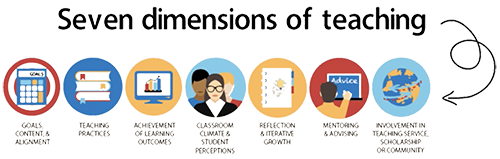
Teaching Effectiveness Framework
Colorado State University developed The Teaching Effectiveness Framework (TEF), which is comprised of seven essential, interrelated domains of evidence-based teaching practices—for face-to-face and online instruction. See https://tilt.colostate.edu/prodev/teaching-effectiveness/tef/ for additional information and resources.
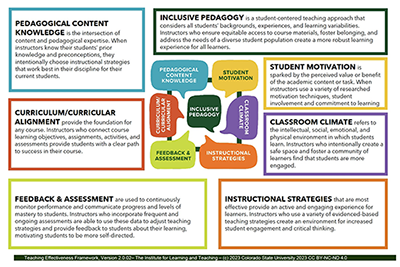
What do these frameworks have in common? First, evaluating quality teaching is complex and multi-dimensional. Faculty should document effective teaching practices using data from a variety of resources. Second, at minimum, quality teaching relies on teaching practices/instructional strategies, feedback and assessment/achievement of learning outcomes, classroom climate, and curricular alignment/goals, content, alignment.
Evidence-based teaching means that the strategies you implement in the classroom are grounded in research on how people learn and in data gathered from actual students. Teachers also collect evidence from their own classrooms—student performance, feedback, and reflections—to systematically document what supports student learning.
By using evidence to guide decisions, teaching becomes more intentional, effective, and responsive, rather than being left to trial-and-error or tradition alone.
DID YOU KNOW...
- Instructors are the single most important influence on their students’ success in and outside the classroom (Haras et al., 2017).
- Evidence-based pedagogical practices like active learning lead to increased retention for underserved students (Singer-Freeman & Bastone, 2016).
- Effective teaching practices are a strong predictor of graduation because of their influence on academic achievement (Pascarella & Terenzini, 2005).
- A good teacher-student relationship facilitates a relaxed and pleasant learning state for students, and positive teacher behaviors–such as guidance, motivation, timely feedback, and other supportive behaviors–all promote students’ learning participation (Li & Xue, 2023).
- Better teaching leads to better student outcomes, which is good for the institution. Better student outcomes impact attrition, the number of courses repeated, and time to graduation (American Council on Education, 2018)
Additional Readings
Interested in reading more about teaching effectiveness? The A&S Faculty Teaching Resources Team has you covered with various links to additional readings.
Additional Teaching Effectiveness Readings